
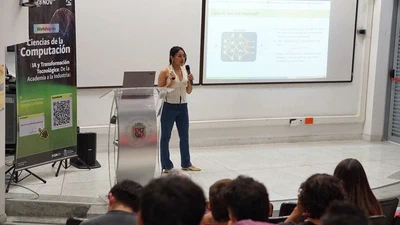
Regularización con cotas de Lipschitz
En esta charla se introduce un metodo para reducir el sobreajuste en redes neuronales usando una regularización adaptativa basada en cotas de Lipschitz (LBA).

I am currently a Ph.D. Candidate in Engineering at Universidad de los Andes (Colombia) focusing on multi-agent AI systems and cooperative resilience property. I began this program in 2023, supported by a competitive scholarship (awarded by Google DeepMind). I hold a Master’s degree in Applied Mathematics, which I completed in 2022. My thesis centered on neural networks and theoretical approaches to mitigating overfitting, combining mathematical principles with practical AI applications. Prior to that, I earned a Bachelor’s degree in Electronic Engineering in 2018, where I developed a strong foundation in systems design, programming, and signal processing.
Ph.D. in Engineering
Universidad de los Andes, Colombia
M.Sc. in Applied Mathematics
Universidad Nacional de Colombia
B.Sc. in Electronic Engineering
Universidad de Nariño
My research focuses on understanding and designing resilient multi-agent systems, particularly mixed-motive settings such as social dilemmas. I use inverse reinforcement learning (IRL)—with an emphasis on preference-based reward inference—to reveal latent social objectives and leverage the notion of cooperative resilience to guide reward learning that sustains collaboration under disruption (e.g., resource scarcity, failures, and strategic/adversarial behavior). The goal is to develop agents that adapt, maintain performance and fairness, and thrive despite shocks and non-stationarity—ultimately aligning individual incentives with collective well-being and long-term stability.
Please reach out to collaborate 😃
En esta charla se introduce un metodo para reducir el sobreajuste en redes neuronales usando una regularización adaptativa basada en cotas de Lipschitz (LBA).
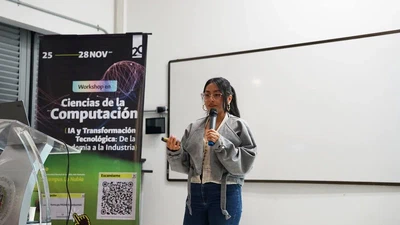
En esta charla hablaremos sobre mi investigación actual en sistemas multiagente de intereses mixtos y la experiencia en el camino del doctorado.
A personal reflection on attending NeurIPS 2025, highlighting the scientific environment and the human experience of a big AI conference.
Cooperative AI is not only a technical challenge but also a question about how to design systems that balance individual incentives and collective welfare. In this first edition, I …
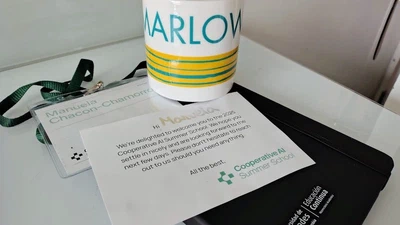
Highlights from my experience at the Cooperative AI Foundation Summer School — where researchers from around the world gathered to discuss how cooperation and AI can help address …